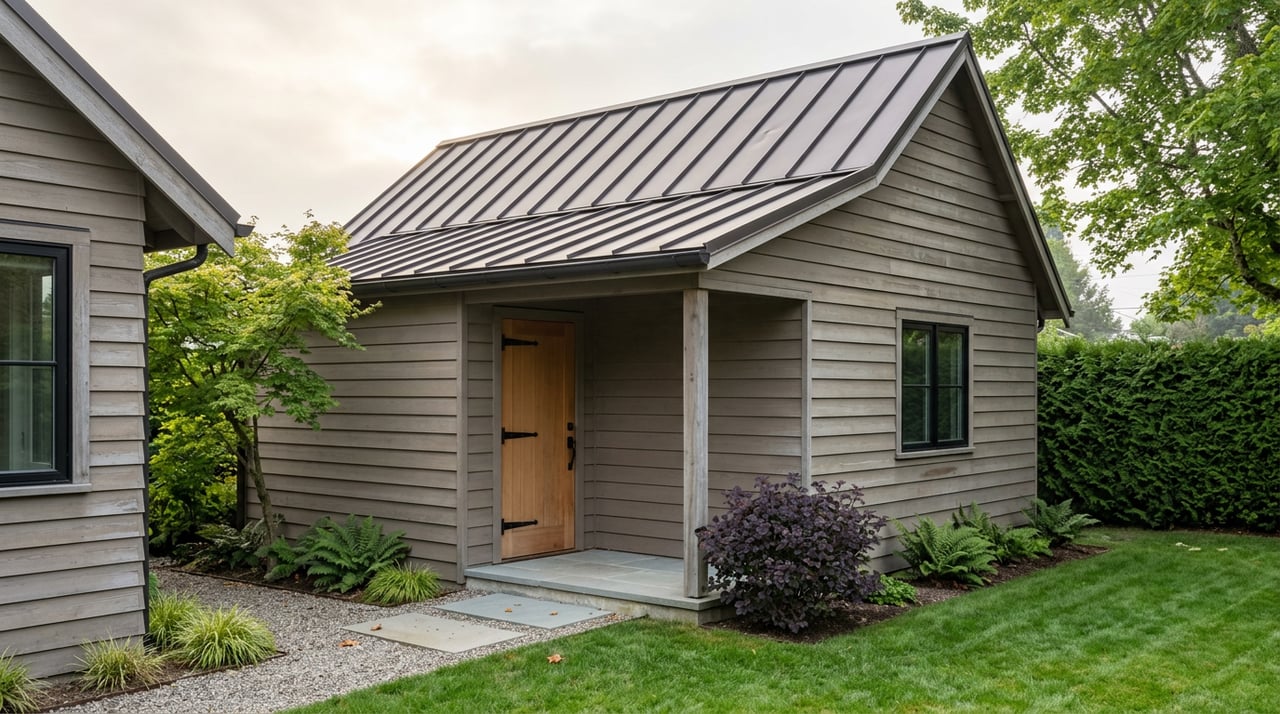
If you own a house in Redmond and you have heard that state law now lets you add rental units to your lot, the question worth asking is not whether you can build one. It is what you are actually allowed to do with it once it exists, because that answer is a lot narrower than the headlines suggest.
Washington's House Bill 1337 took effect on July 23, 2023, and it did something unusual for state housing law: it stopped suggesting and started requiring. Cities that plan under the Growth Management Act, Redmond included, must now allow at least two accessory dwelling units on any residential lot that meets the minimum size for the primary house. That can be one attached and one detached unit, two attached, or two detached. Garage conversions have to be permitted. Cities cannot cap the size of an ADU below 1,000 square feet. For homeowners who have spent years watching Eastside zoning close doors rather than open them, this reads like a windfall.
It is a real opportunity. It is also not the free-money story most ADU explainers make it sound like, and the details that get left out are exactly the ones a Redmond homeowner needs before breaking ground.
What the Law Actually Guarantees
The statute's language is unusually blunt for zoning code. Cities "must allow" the two-unit minimum. They "may not require" owner occupancy as a condition of building one. They cannot impose parking mandates beyond a narrow exception for short-term rental use. This is a state legislature telling cities, in plain terms, that the old local playbook of restricting ADUs through parking minimums and occupancy rules no longer works.
That is the mandate. What follows it, in practice, is where the story gets more specific to Redmond.
The Part That Doesn't Show Up in the Headline
Two features of an ADU matter more to your bottom line than whether you are legally permitted to build one, and both get skipped in most coverage of the new rules.
First, Property Managers Seattle says an ADU cannot be sold separately from the primary house. That ties the ADU to the property as a whole. That means you cannot recoup your construction cost by selling the ADU on its own. Whatever value it adds is reflected in the whole property's value when you eventually sell.
Second, Washington's 2026 rent-increase cap under House Bill 1217 sets a ceiling of 9.683% on annual rent increases for most covered tenancies, and that generally includes ADU rentals. But there is an exemption, and it is narrower than most owners assume. It applies only to owner-occupants who rent out no more than two units or rooms, including an ADU, while they continue to live in the primary residence. If you are not living on the property, the exemption does not apply to you. In practical terms, the law gives more pricing flexibility to a homeowner who builds an ADU to house a family member or rent to a tenant while living next door than it gives to an investor who buys a property purely to run two rental units. That asymmetry is the actual incentive structure behind the new rules, and it is easy to miss if you only read the "two ADUs per lot" part of the story.
| What you hear | What actually applies |
|---|---|
| "You can add two rental units to any lot" | True for qualifying lots, but configuration and size limits still apply |
| "No parking requirements, no occupancy rules" | State law prohibits those mandates in general, but confirm current status directly with Redmond's permit office rather than trusting an older code page |
| "Build it and rent it for market rate" | The full rent-increase cap applies unless you occupy the primary residence and rent no more than two units or rooms, including an ADU |
| "An ADU is a second asset you can sell later" | As noted above, the ADU remains part of the property rather than a separately sellable asset |
Redmond's Own Rulebook Keeps Moving
Here is something worth knowing before you rely on any single search result for Redmond's current ADU rules: the city has amended its ADU code twice since the start of 2025. Ordinance 3186 went into effect in January 2025, and Ordinance 3220 followed in June 2025. Search for Redmond's ADU requirements today and you may land on code language written before either amendment, some of which still references an owner-occupancy affidavit that state law arguably no longer permits cities to require. The contradiction between older and newer Redmond code text is not a typo. It reflects a city actively rewriting its rules to catch up with a state mandate that keeps evolving, and it means the responsible move before you design anything is a call to Redmond's permit office rather than a confident read of whatever page ranks first.
That instability is not unique to Redmond, and it is not close to finished. Washington's periodic Growth Management Act update deadline for ADU compliance has been extended to December 31, 2026 for jurisdictions whose updates were originally due mid-year, which means some Eastside cities are still formally catching up their code to the 2023 state law. And in 2026 the legislature kept going: House Bill 1345, effective June 11, 2026, opened a new county-opt-in pathway allowing one detached ADU per parcel in unincorporated rural areas outside urban growth boundaries. That specific expansion does not apply inside Redmond's city limits, but it is a signal that the state is not done touching this topic, and city ordinances tend to follow.
How Redmond Compares to Its Eastside Neighbors
Context helps here, because Redmond is not the only Eastside city working through this. Bellevue is the more dramatic case: detached ADUs were prohibited there entirely until Ordinances 6851 and 6852 took effect on July 1, 2025, bringing the city into compliance with the state mandate. Kirkland moved earlier, adopting its first round of ADU code amendments in late 2023 and revising them again in 2024. Redmond sits in the middle of that timeline, neither the earliest mover nor the last holdout, but still mid-adjustment rather than settled.
For a buyer comparing cities, this matters beyond curiosity. A lot in a city still finalizing its ADU code carries more regulatory uncertainty than one in a city that settled its rules two years ago. That uncertainty is not necessarily a reason to avoid Redmond, but it is a reason to verify current requirements property by property rather than assuming last year's article still holds.
What This Means for the Math
If you are weighing whether to add an ADU to a Redmond lot, the honest framing is this: the state has removed most of the legal obstacles, but it has not created a standalone financial asset. What it has created is a way to add housing capacity and modest rental income to a property you plan to keep living on, with real income upside if you occupy the primary home and are exempt from the full rent cap. What it has not created is a shortcut to recouping construction costs, or a rental-rate free-for-all for an off-site investor running two units on a lot they do not live on.
For a premium seller weighing pre-listing improvements, that reframes the pitch. An ADU contributes to the value of the whole property rather than offering a separate stream of sale proceeds. For an investor comparing Eastside cities, the owner-occupancy distinction in the rent cap is worth more attention than the headline "two ADUs per lot" ever gets.
A Few Questions Worth Asking
Can I sell my Redmond ADU separately from the main house? No. As noted above, the ADU remains part of the whole property rather than a separately sellable asset.
Does the Washington rent cap apply to my ADU if I rent it out? Generally yes, at the 2026 ceiling of 9.683% annually. The exemption is narrow: it applies only if you occupy the primary residence and rent no more than two units or rooms total, including the ADU.
Has Redmond finished updating its ADU rules, or could they change again? Given two ordinance amendments since the start of 2025 and a state compliance deadline extending into December 2026, treat any specific number you find online (parking, notice requirements, occupancy conditions) as a starting point, not a final answer. Confirming directly with the city before you design anything is the only way to be certain.
Whether you are weighing an ADU as a way to house family, generate income while you stay in your Redmond home, or simply want to understand how a property's value holds up against this shifting rulebook, a conversation grounded in what is actually happening in Redmond right now beats a search result written before the last ordinance change. Pacific Northwest Partners can walk through what an ADU means for your specific lot and timeline. Request a complimentary home valuation or schedule a consultation to talk through the details before you commit to anything.
This article is general information, not legal, tax or financial advice. Consult a qualified professional about your situation.